OzHarvest is passionate about minimising food waste and protecting our environment for future generations. Here’s why…
The World:
- There is enough food produced in the world to feed everyone. [1]
- One third of all food produced is lost or wasted –around 1.3 billion tonnes of food –costing the global economy close to $940 billion each year.[2]
- One in nine people do not have enough food to eat, that’s 793 million people who are undernourished.[3]
- If one quarter of the food currently lost or wasted could be saved, it would be enough to feed 870 million hungry people.[4]
- Almost half of all fruit and vegetables produced are wasted (that’s 3.7 trillion apples). [5]
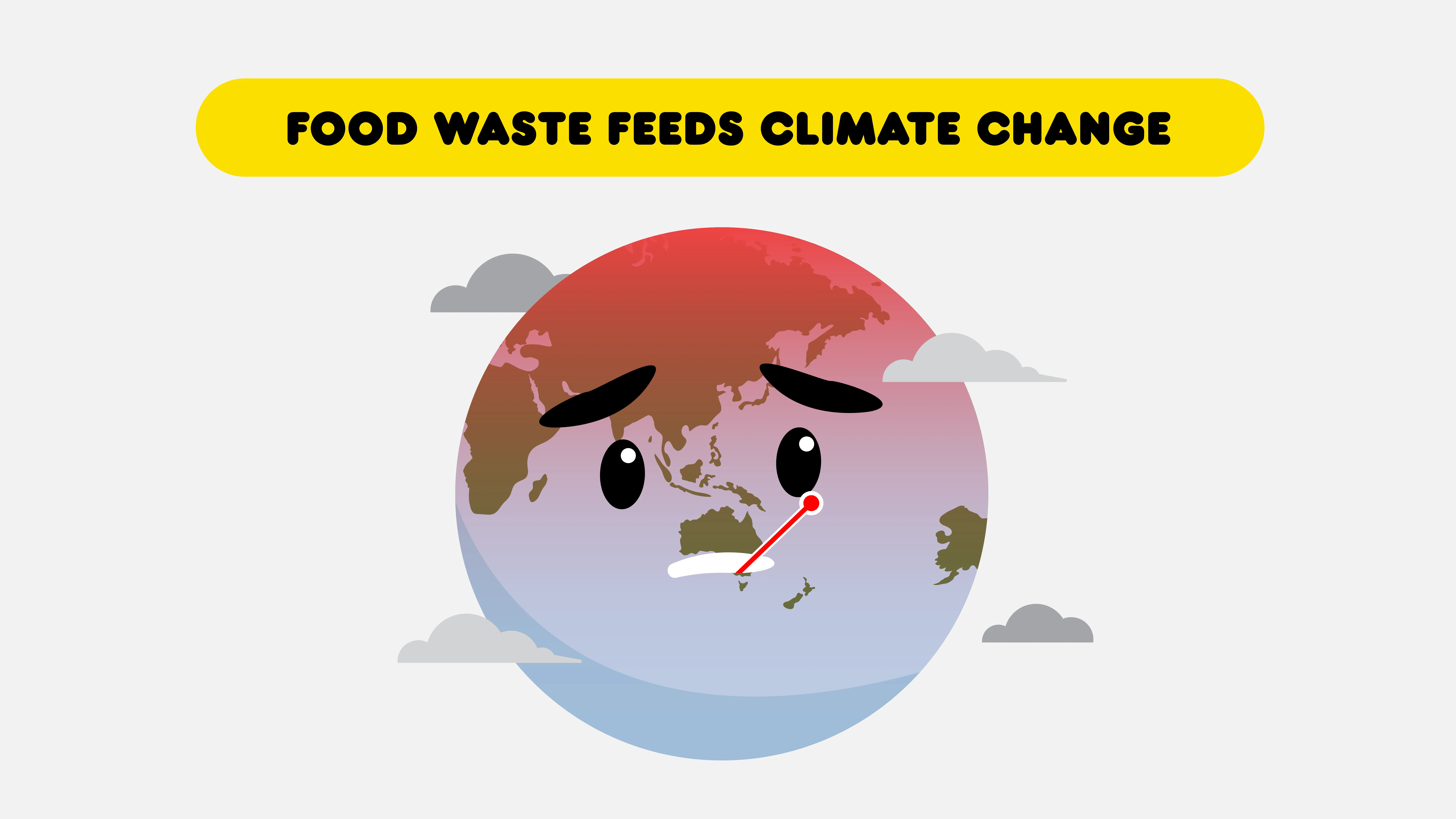
- 8% of greenhouse gases heating the planet are caused by food waste.[6]
- If food waste was a country, it would be the third biggest emitter of greenhouse gases after USA and China.[7]
- Eliminating global food waste would save 4.4 million tonnes of C02 a year, the equivalent of taking one in four cars off the road. [8]
- Throwing away one burger wastes the same amount of water as a 90-minute shower.
In Australia:
- The Government estimates food waste costs the Australian economy $20 billion each year. [9]
- Over 5 million tonnes of food ends up as landfill, enough to fill 9,000 Olympic sized swimming pools.[10]
- One in five shopping bags end up in the bin = $3,800 worth of groceries per household each year.[11]
- 35% of the average household bin is food waste. [12]
- Nearly four million people experience food insecurity each year, one quarter are children.[14]
- Over 710,000 people rely on food relief each month, one quarter are children.[14]
- Regional and remote communities are being hit the hardest and are a third more likely to experience food insecurity than those living in capital cities.[14]
[1] 2016 World Hunger and Poverty Facts and Statistics
[2] FAO Save Food Global Food Waste and Loss Initiative
[3] FAO The State of Food Insecurity in the World 2015
[4] FAO The State of Food Insecurity in the World 2015
[5] https://www.fao.org/save-food/resources/keyfindings/infographics/fruit/en/
[6] FAO Food Wastage Footprint Report 2013
[7] FAO Food Wastage Footprint Report 2013
[8] https://www.yousustain.com/footprint/howmuchco2?co2=4%2C400%2C000+tons
[9] https://www.joshfrydenberg.com.au/siteData/uploadedData/Minister%20Frydenberg%20-%20Media%20Release%20-%20Pre%20Food%20Waste%20Roundtable_d0300e69-58ce-44ca-820d-8ccdfd1dac0b.pdf
[10] https://www.environment.gov.au/topics/environment-protection/nwp/reporting/organic-waste
[11] https://www.epa.nsw.gov.au/wastegrants/organics-infrastructure.htm
[12] https://www.epa.nsw.gov.au/wastegrants/organics-infrastructure.htm
[13] ACOSS Poverty in Australia 2016
[14] FoodBank Hunger Report 2018